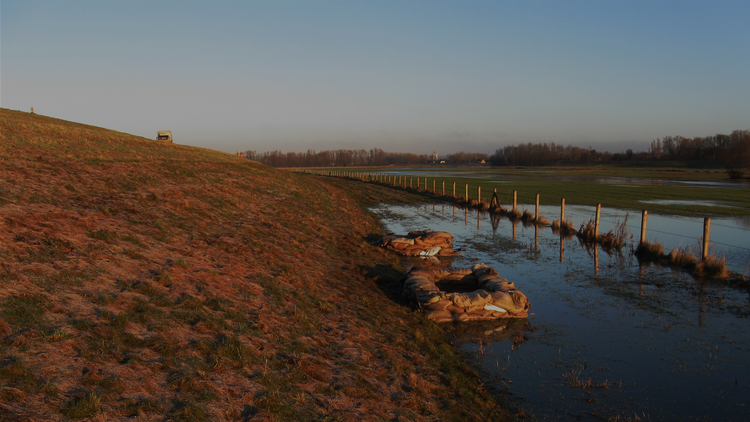
Backward Erosion Piping is a complex process where water seeping under a dike dislodges sand, potentially causing collapse.
To prevent widespread flooding, 2000 kilometres of dikes in the Netherlands must be strengthened over the next 30 years, costing ca 15 billion. Current assessment methods for Backward Erosion Piping (BEP) use overly simplified models that don’t account for the intricate physics beneath the surface.
The Digital Dikes project addresses BEP failure risk by developing advanced digital models that capture the 3D nature of BEP and the variability of soil and water conditions. These models will be informed by real-world monitoring data and tested through extensive collaborations with industry, government, and international partners.
Digital Dikes will create fundamental understanding of the physical processes related to BEP across the different scales and propose innovative solutions to assess dike safety. Together with industrial partners, we will develop advanced digital models with varying degrees of detail, integrated into a flexible open-source tool, assimilating monitoring data to give probabilistic predictions. This framework can assess the probability (and severity) of pipe progression as a function of dike geometry, variability of subsurface properties and hydraulic loads. The novel technology will be tested through real-world case studies, co-designed with industry, government, and international users.
Digital Dikes is an ambitious and high-profile research programme, funded by the Dutch Research Council (NWO). The expected societal and economic impact is substantial: by refining BEP risk assessments, we will provide insights to allocate financial and human resources to areas where reinforcement or monitoring is most needed. Integration of the outcomes into upcoming (inter-)national dike programs will strengthen the position of Dutch dike technology. The developed models will aid the Digital Dikes partners to provide more cost-effective solutions in the international market.
Digital Dikes involves partners from six universities in the Netherlands and abroad. The consortium is supported by a broad group of end users and governmental stakeholders, including Water Authorities, Rijkswaterstaat, STOWA, the Dutch Flood Protection Programme, and international organisations. Further contributors, such as the ICOLD European Working Group on Internal Erosion and ISSMGE Techinal Commitees provide specific expertise and know-how. More details following the link.